"Transform Data Center Security Into Verifiable Proof"
Why Security Claims Are No Longer Enough for Data Centers
Data centers today face a different challenge than they did a few years ago. It is no longer enough to say that systems are secure. Customers handling sensitive data increasingly want proof that workloads are running in a trusted environment and that unauthorized changes can be detected before they become serious incidents. This is especially important for SME data centers and regional cloud providers trying to win business in healthcare, defense, telecom, and other regulated sectors. These providers may already have strong infrastructure, but they often lack a clear way to demonstrate trust in a verifiable and continuous manner.
Key Points:
- Sensitive customers want proof, not only security claims.
- Trust has become a commercial requirement, not just a technical one.
- Regional and SME operators need ways to show trust without rebuilding their infrastructure.
How TeyzSec Adds a Trust Layer to Existing Infrastructure
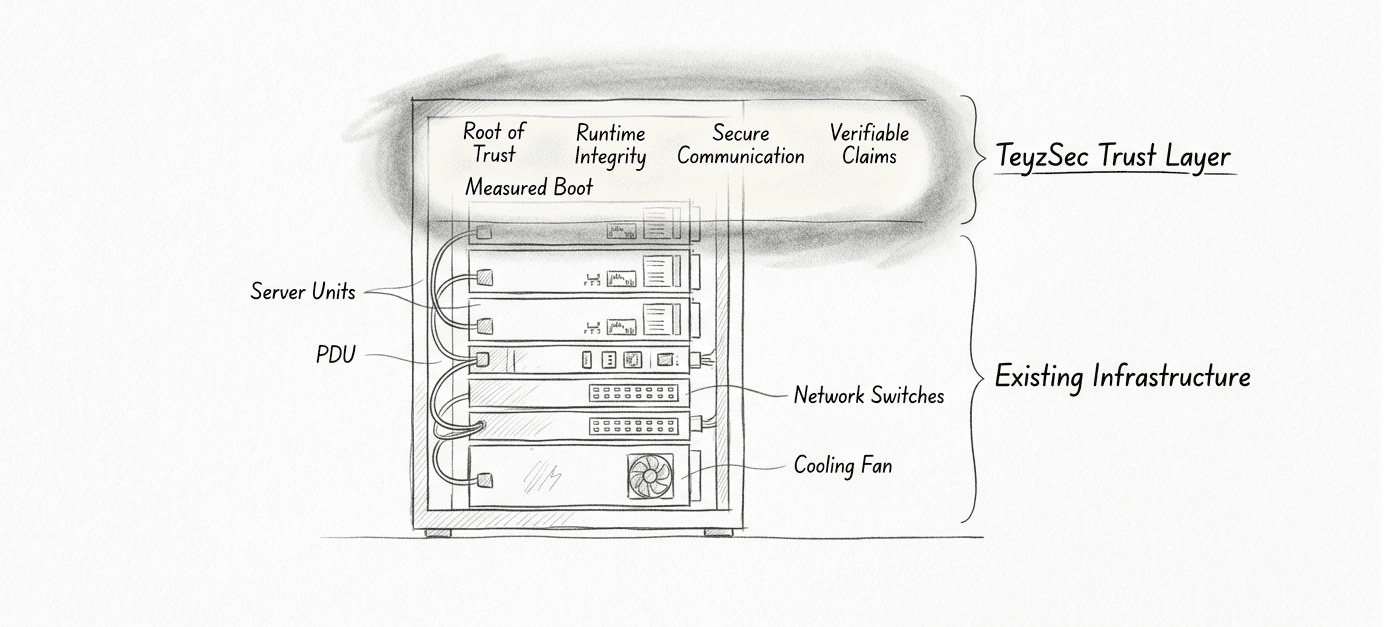
TeyzSec adds a trust layer on top of existing data center infrastructure. Instead of asking operators to replace their stack, it helps them strengthen trust on top of what they already run. Using confidential computing and privacy-enhancing technologies, TeyzSec helps data centers show that sensitive workloads are running in a trusted environment. This makes it easier for operators to support customers with higher security expectations while keeping deployment practical for modern cloud, edge, and container-based environments.
Key Points:
- Works on top of existing infrastructure.
- Uses confidential computing and PETs as the technical foundation.
- Helps operators offer trusted compute without a full rebuild.
From Security Monitoring to Verifiable Proof
Traditional security often focuses on monitoring, alerts, and after-the-fact investigation. TeyzSec’s approach is different because it is built around proving trust, not only reacting to incidents. In practical terms, this means helping operators confirm that approved workloads are the ones actually running, and that unexpected changes can be identified and acted on quickly. This shifts security from a promise into something a provider can show to customers, partners, and regulated buyers.
Key Points:
- Moves from “we are secure” to “we can prove trust.”
- Helps verify that workloads remain in an approved state.
- Strengthens buyer confidence for sensitive processing environments.
Protecting Sensitive Workloads in Real Time
Sensitive workloads do not only need perimeter protection. They need protection while they are running, especially in environments where multiple systems, services, and users interact continuously. TeyzSec is designed to help operators maintain trust during live operations by detecting unauthorized changes, enforcing approved behavior, and supporting fast response when something falls outside policy. This model is built to strengthen protection without creating heavy operational burden.
Key Points:
- Focuses on trust during live workload execution.
- Helps detect unauthorized changes in real time.
- Supports strong protection with low operational overhead.
Where Trusted Compute Matters Most
Trusted compute matters most in sectors where sensitive data, regulatory pressure, or operational risk is high. That includes healthcare, defense, telecom, and other regulated or high-trust industries that need stronger assurance before placing workloads with a provider. For many SME data centers and regional cloud providers, this creates both a challenge and an opportunity. The challenge is proving trust clearly enough to satisfy these customers. The opportunity is that providers who can demonstrate trust may unlock a stronger customer base and differentiate themselves from commodity infrastructure providers.
Key Points:
- High-trust sectors need stronger assurance.
- Trust can influence who wins sensitive workloads.
- Proving trust can become a growth advantage for regional providers.
Responding to Modern Threats Without Rebuilding the Stack
Many operators already have substantial investment in infrastructure, security tools, and operational workflows. The practical question is not whether they should replace everything, but how they can strengthen trust without creating major disruption. This is where TeyzSec’s positioning is strong. By adding a trust layer to existing environments, operators can improve how they verify workloads, respond to unexpected changes, and support higher-assurance use cases without redesigning their entire platform.
Key Points:
- Protects existing infrastructure investments.
- Improves trust without major architectural change.
- Makes stronger security commercially usable for smaller providers.
Best Practices for Adding a Trust Layer to Data Center Operations
The first step is to identify which workloads require the highest level of trust. Not every system needs the same controls, so operators should start with the environments that handle sensitive data or are most relevant to regulated customers. The second step is to focus on proof that customers can understand. Instead of leading with technical detail, providers should show how they protect sensitive workloads, how they reduce unauthorized changes, and how they demonstrate trust on top of existing infrastructure. The goal is to make trust visible, understandable, and useful in both operations and sales conversations.
Key Points:
- Start with the most sensitive workloads.
- Focus on proof that buyers understand.
- Use trust as both a security control and a business enabler.
Conclusion
The future of data center security is not just stronger protection. It is verifiable trust.
For SME data centers and regional cloud providers, this creates a real opportunity. The providers that can prove trust for sensitive workloads will be in a better position to win customers in healthcare, defense, telecom, and other regulated sectors. Those that cannot may continue to struggle, even if their infrastructure is already strong.
Key Takeaways:
- Security claims alone are no longer enough.
- Sensitive workloads require environments that can demonstrate trust.
- TeyzSec adds that trust layer on top of existing infrastructure.
TeyzSec helps turn security from a promise into proof. By making trusted compute more practical and accessible, it enables data centers to grow into higher-trust markets without rebuilding from scratch.
Now is the time to move from saying your infrastructure is secure to showing that it is trusted.
Useful Links & Resources
- - [NIST Cybersecurity]: https://www.nist.gov/cybersecurity
- - [CISA Resources]: https://www.cisa.gov/resources-tools
- - [Palo Alto Networks]: https://www.paloaltonetworks.com/cyberpedia
- - [Krebs on Security]: https://krebsonsecurity.com/
- 📚 Related Blog Posts:
Frequently Asked Questions
How does TeyzSec help data centers enhance their security posture?
TeyzSec focuses on implementing advanced threat detection and incident response strategies tailored for data centers. By leveraging machine learning and behavioral analytics, I help organizations identify vulnerabilities and effectively remediate threats before they impact operations.
What are the key steps in implementing TeyzSec's security solutions for data centers?
First, I recommend conducting a comprehensive security assessment to identify weaknesses. Next, we integrate TeyzSec's solutions, which include continuous monitoring and automated threat response. Lastly, I ensure regular training and updates for the staff to adapt to evolving threats.
What challenges do data centers face when trying to prove their security measures?
One major challenge I often encounter is the lack of standardized metrics for cybersecurity efficacy. Many data centers struggle with demonstrating compliance and the effectiveness of their security investments, which can lead to mistrust from stakeholders.
What best practices should data centers follow to turn security into proof?
In my view, best practices include establishing transparent reporting mechanisms, regularly conducting penetration tests, and keeping detailed logs of security incidents. Additionally, adopting frameworks like NIST or ISO can provide a solid foundation for proving the robustness of security measures.
How is automation and AI shaping the future of security in data centers?
From my perspective, automation and AI are game-changers for data center security, enabling real-time threat detection and response. As these technologies evolve, I foresee a future where predictive analytics will help anticipate attacks, further solidifying security measures and operational resilience.