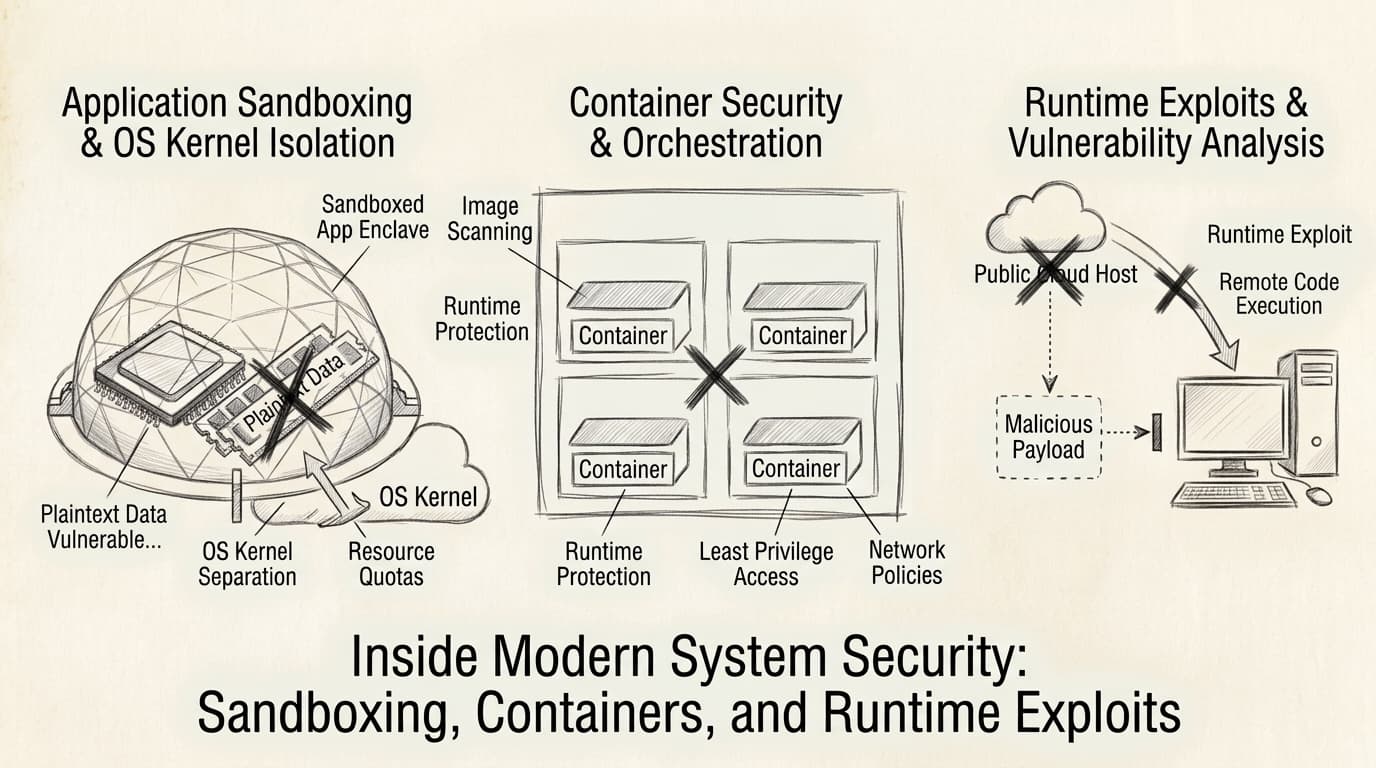
In today’s computing landscape, security is no longer just about preventing attacks—it is about containing damage when things inevitably go wrong. Modern software systems are complex, layered, and built on abstractions that, while powerful, introduce subtle vulnerabilities. As attackers continue to exploit these weaknesses, traditional perimeter-based defenses are proving insufficient. This has shifted the focus of cybersecurity toward isolation, containment, and controlled execution, which form the foundation of modern platform security.
Two of the most important technologies enabling this shift are sandboxing and containers. Rather than attempting to eliminate all bugs—an impossible task—these mechanisms limit how much harm a compromised application can cause. Sandboxing achieves this by restricting what a program can access at runtime, while containers provide lightweight isolation by leveraging kernel features such as namespaces, control groups, and system call filtering. Together, they form a critical defense layer that helps prevent local failures from becoming system-wide compromises.
Understanding these technologies requires looking beneath the surface. Sandboxing relies on operating system primitives such as virtual memory, system call mediation, and access control policies to enforce strict boundaries between applications and system resources. Containers, while often perceived as lightweight virtual machines, actually share the host kernel and depend heavily on correct configuration and kernel-level security mechanisms. This makes them powerful—but also risky if misunderstood.
Throughout this blog, I explore how sandboxing and containers work from a systems perspective, drawing connections between virtual memory, access control, runtime behavior, and isolation mechanisms. By examining how modern operating systems enforce security—and how attackers exploit unintended behavior—we gain a clearer understanding of both the strengths and limitations of these technologies. Ultimately, this discussion highlights why sandboxing and containers are not just deployment tools, but essential components of modern defensive security architecture.